

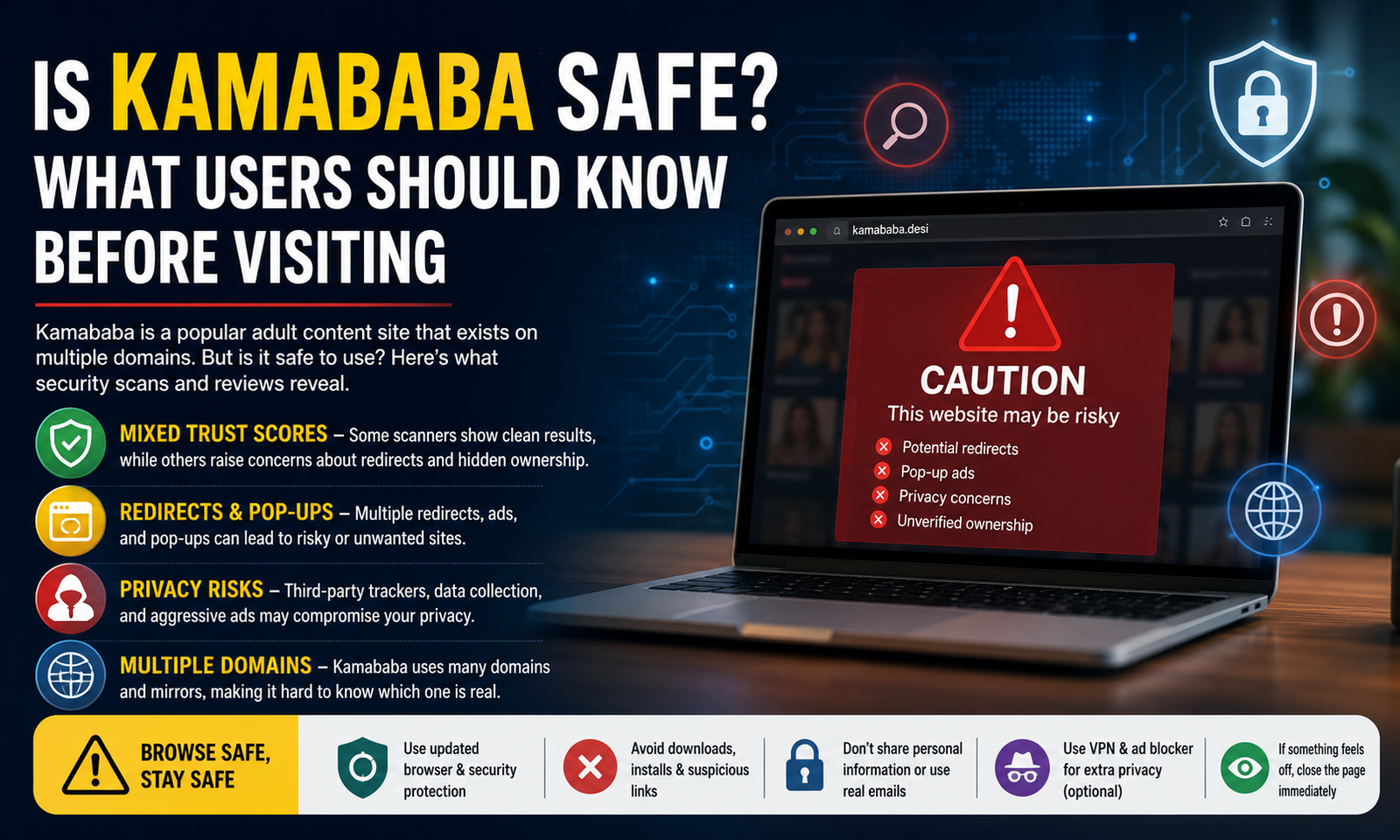
Many people search “Is Kamababa safe?” because the name appears across different links, domains, and adult-content directories. That alone can make the answer confusing. One person may be talking about kamababa.com, another may mean kamababa.desi, while someone else may have found a newer-looking Kamababa mirror site or a link shared on social media.
The honest answer is this: Kamababa safety is not a simple yes-or-no topic. Some security scanners show clean results for specific Kamababa domains at the time they were checked, while other review sites raise concerns about redirects, hidden ownership, adult website risks, and possible copycat domains.
For example, PCrisk reported that kamababa.com had 0 detections from 91 threat engines, a 96/100 trust score, and “No Threats Found” when it was scanned on June 24, 2026. The same report also recommended a fresh scan because a site’s security status can change. Gridinsoft gave kamababa.desi a 61/100 trust score, noting no major malware or phishing detections, but also flagged a redirect to another domain, which reduces transparency for visitors.
So before opening any Kamababa link, it is better to understand what these safety signals actually mean.
Quick Answer: Is Kamababa Safe?
If you are asking is Kamababa safe to visit, the safest answer is: treat it with caution.
A clean scan does not always mean a website is completely safe. It only means the scanner did not find active malware, phishing, or blacklist warnings at the time of checking. That is useful, but it does not cover everything. A site can still expose users to pop-up ads, third-party trackers, forced redirects, fake buttons, browser notification traps, or risky external pages.
This matters even more with adult-oriented websites because many of them depend on aggressive ad networks. ScamAdviser’s review of related Kamababa-style domains warned about domain switching, hidden ownership, pop-ups, redirects, and malvertising concerns.
In simple words, Kamababa may not be automatically unsafe on every domain, but it should not be treated like a fully trusted website either.
Why Kamababa Safety Results Are Mixed
Different safety tools look at different things. This is why one site may say Kamababa is safe, while another says it is risky.
A Kamababa malware scan usually checks whether the domain appears in malware databases, phishing lists, or known threat engines. That is what PCrisk did when it checked kamababa.com and found no threat engine detections.
A website trust score, however, may look at more than malware. It can include domain age, traffic history, SSL status, ownership transparency, redirect behavior, and reputation signals. Gridinsoft’s review of kamababa.desi found positive signals such as no major malware or phishing detections, domain history, and an active SSL certificate, but it also noted a redirect to www.kamababax.com.
That is why users should avoid judging the site from one score alone. A domain can pass a virus check and still have privacy or browsing risks.
What PCrisk Says About Kamababa.com
PCrisk’s scan of kamababa.com is one of the more positive signals. The report categorized the site as adult content, listed 0/91 threat engine detections, gave it a 96/100 trust score, and showed No Threats Found at the time of analysis.
That sounds reassuring, but there are two important details to remember.
First, PCrisk itself says a fresh scan is recommended because security status may change. A website can be clean today and risky later if its ads, scripts, redirects, or linked pages change.
Second, the scan result applies to that exact domain at that exact time. It does not automatically prove that every Kamababa new link, Kamababa mirror site, or similar-looking domain is safe.
So, if someone sends you a Kamababa link, do not assume it is the same site PCrisk checked. Always look closely at the spelling and domain extension.
What Gridinsoft Says About Kamababa.desi
Gridinsoft gave kamababa.desi a more cautious but not fully negative review. It reported a 61/100 trust score, no major malware or phishing detections, a longer visible domain history, an active SSL certificate, and presence in public traffic rankings.
The biggest caution point was the redirect. Gridinsoft noted that kamababa.desi redirects visitors to another domain, and while redirects can be normal during site changes, they make it harder for users to judge where they are actually going.
This is important because Kamababa redirects can create confusion. A user may type one address, click one search result, or open one shared link, but end up somewhere else. That final destination may not have the same safety rating as the original domain.
For users, this means one thing: do not just check the link you clicked. Check the page where you actually land.
What ScamAdviser Says About Kamababa-Related Domains
ScamAdviser gives mixed signals depending on the exact domain.
For kamababa.info.in, ScamAdviser showed positive highlights such as a valid SSL certificate and DNSFilter considering the website safe. But it also listed negative highlights, including hidden WHOIS ownership, low visitor numbers, and recent domain registration.
For kamababa.de, ScamAdviser marked it as “Very Likely Safe,” with positive highlights including a valid SSL certificate and DNSFilter considering the website safe. Still, it also mentioned low visitor numbers and warned that the site had not been scanned recently.
This is a good example of why Kamababa domain safety depends on the exact URL. One domain can look more stable, another can look new, and another can redirect somewhere else.
A valid SSL certificate is helpful, but it is not a full safety guarantee. HTTPS only means the connection between your browser and the site is encrypted. It does not prove that the site owner is trustworthy, that ads are clean, or that every link on the page is safe.
ScamMinder’s Warning About Kamababa.desi
ScamMinder takes a much stricter view of kamababa.desi. Its page gives the site a 10/100 safety score, labels it high risk, and advises users to exercise caution. It also mentions adult content, possible malware exposure, inappropriate content, and legal concerns as reasons for caution.
This does not mean every other scanner will agree with ScamMinder. In fact, Gridinsoft’s review is less severe. But it does show why users should not rely on one positive scan and ignore other warning signs.
When different tools disagree, the smart approach is to follow the stricter safety habit: avoid downloads, avoid permissions, avoid personal data, and leave the page if anything feels suspicious.
Is Kamababa Safe from Malware?
Based on the available scanner reports, some Kamababa domains did not show active malware at the time they were checked. That is a positive sign. But Kamababa malware risk is still something users should take seriously because malware does not always come from the main page itself.
On adult-content websites, risk often comes from:
Fake play buttons
Pop-up windows
Redirect chains
Browser notification prompts
Misleading download buttons
Fake virus alerts
Ads that open new tabs
External pages pretending to be updates or apps
ScamAdviser’s review of related Kamababa-style sites specifically discussed pop-ups, sudden redirects, misleading buttons, and malvertising risks on such platforms.
This is why a Kamababa virus check should not stop at the homepage. Even if the main domain is clean, the ads and redirected pages may not be.
A safer rule is simple: do not download anything from Kamababa or similar sites. Do not install APK files, browser extensions, media players, or “required updates.” If a page says you need to install something to watch content, close it.
Privacy Risks Before Visiting Kamababa
Many users only ask about viruses, but Kamababa privacy risks may be just as important.
Adult-oriented sites can use cookies, analytics scripts, advertising trackers, fingerprinting tools, and third-party embeds. These may collect technical details such as your IP address, browser type, device type, approximate location, screen size, and browsing behavior.
ScamAdviser’s kamababa.info.in review also warns that adult-oriented websites may include third-party trackers and that users should be careful when browsing this type of content.
Private browsing can help reduce local history on your device, but it does not make you invisible. Your internet provider, network administrator, visited websites, and some trackers may still see parts of your activity.
A VPN for privacy may help hide your IP address from the site, but it does not make a risky website safe. If you click a fake download, allow spam notifications, or enter personal details, a VPN will not protect you from those choices.
Kamababa Pop-Ups, Ads, and Redirects
The biggest everyday concern with Kamababa-style sites is not always the main page. It is often the advertising around it.
Free adult sites usually rely on ad revenue. Some use cleaner ad networks, while others show aggressive ads, fake buttons, adult offers, gambling pages, fake dating prompts, or device-warning scams.
That is where Kamababa pop-up ads and Kamababa redirects become risky. A visitor may click what looks like a normal button, but the page may open a new tab, send them to another site, or ask them to allow notifications.
Be careful with messages like:
“Your phone is infected”
“Allow notifications to continue”
“Download this player”
“Install this app to watch”
“Your browser is outdated”
“You won a prize”
These are common tricks used across risky websites. They are designed to get a click, permission, install, or sign-up.
A good safe browsing habit is to close any page that pushes urgent warnings or asks for unnecessary permissions.
Kamababa Domain Switching and Fake Links
One of the biggest reasons people search “Is Kamababa safe?” is because there are several related names and domains online.
You may see search variations like Kamababa new link, Kamababa.desi, kamababa.com, TheKamaBaba, kamababax, or other similar-looking domains. Some may be old links, some may be mirrors, and some could be unrelated copycats.
ScamAdviser’s article on TheKamaBaba.com and Kamababa.desi discussed a domain change message and warned that frequent moves in the adult streaming space can be linked to blocks, complaints, or security concerns.
A Kamababa domain switch does not automatically prove a scam, but it does reduce trust. When a site keeps changing addresses, users have a harder time knowing which version is real, who controls it, and whether the current page is the same one reviewed by safety tools.
This is where fake Kamababa domains can become dangerous. A copycat site can use a similar name, similar layout, or similar search terms to attract traffic. It may then push pop-ups, fake downloads, or phishing pages.
Before opening any link, check:
The exact spelling
The domain extension
Whether the page redirects
Whether the site uses HTTPS
Whether recent scanner results exist
Whether the page asks for strange permissions
Whether the site pushes downloads or installs
If the URL looks slightly wrong, avoid it.
Is Kamababa Safe on Mobile?
A lot of users visit adult websites from phones, so Kamababa mobile browsing deserves extra care.
On Android, the biggest risk is installing unknown APK files. If a Kamababa page or pop-up tells you to install an app, update a video player, or download a file, do not do it. APK files from unknown sources can contain adware, spyware, or other unwanted software.
On iPhone, the risk is usually different. iOS blocks many app-install tricks, but users can still face spam notifications, redirect pages, fake calendar subscriptions, phishing forms, or profile-install prompts.
For safer mobile browsing:
Keep Chrome, Safari, Android, and iOS updated
Do not allow browser notifications from unknown sites
Do not install apps from pop-ups
Do not enter your main email or password
Clear suspicious site permissions
Use built-in browser protection
Close tabs that open automatically
Avoid saving payment details in the browser
If your phone starts showing random notifications after visiting a site, check your browser notification settings. Many spam alerts come from users accidentally tapping “Allow” on a notification prompt.
What to Check Before Opening Any Kamababa Link
Before visiting Kamababa or any similar adult website, take a minute to check the basics. This can save you from fake links and risky pages.
Start with the exact URL. Do not rely on the name alone. Kamababa.com and kamababa.desi are not the same as a random lookalike domain.
Next, use a website safety checker or website security scan. Look for recent results, not old ones. A scan from months ago may not reflect the current page.
Check whether the website redirects. If you type one domain and land on another, be more careful. Redirects are not always bad, but they reduce transparency.
Look for HTTPS, but do not trust HTTPS alone. A scam site can also use an SSL certificate.
Pay attention to your browser. If Chrome, Safari, Edge, or Firefox shows a warning, do not ignore it.
Avoid any page that asks you to:
Download a file
Install an app
Allow notifications
Disable browser protection
Enter personal information
Verify your identity with payment details
Click multiple pop-ups to continue
A safe site should not pressure you into risky actions.
What Not to Do on Kamababa or Similar Sites
If you still decide to visit, protect yourself by avoiding the most common mistakes.
Do not enter personal information. There is no good reason to share your real name, main email, phone number, address, or payment details on an unfamiliar adult site.
Do not reuse passwords. If a site asks you to register, never use the same password you use for Gmail, banking, social media, or work accounts.
Do not click random ads. Many risky pages are designed to look like video controls, download buttons, or system alerts.
Do not download videos, apps, APKs, extensions, or media players from pop-ups.
Do not allow notifications. Browser notifications can be abused to send spam, fake alerts, adult ads, or phishing links directly to your phone or desktop.
Do not assume every Kamababa domain is the same. A clean result for one domain does not protect you on another.
Do not ignore local laws and age restrictions. Adult content rules vary by country, and users should only access legal content where they live.
Safer Ways to Browse Adult Websites Online
The safest option is always to use legal, transparent, well-known platforms that clearly explain who operates them, how content is licensed, and how user data is handled. Unknown adult aggregation sites are usually harder to trust because ownership, advertising, and content sources may not be clear.
For adult website safety, these habits help:
Use an updated browser
Turn on safe browsing protection
Use an ad blocker where allowed
Block third-party cookies
Avoid unknown downloads
Use a separate email if registration is needed
Never save passwords on unfamiliar sites
Do not allow site notifications
Use privacy settings on your browser
Scan suspicious links before opening
Leave immediately if redirects feel aggressive
A VPN for privacy can help hide your IP address, especially on public Wi-Fi, but it should not create false confidence. A VPN does not block every scam, malware page, or phishing attempt.
Why Traffic Does Not Equal Safety
Some users think a website is safe just because many people visit it. That is not always true.
Semrush estimated that kamababa.com received 1.29 million visits in May 2026, with a large share of traffic from India, followed by the United States and Canada. It also showed that users often moved from kamababa.com to domains such as kamababax.com and kamababa.desi.
Traffic can show popularity, but popularity is not the same as trust. Many risky or low-quality sites still get large traffic because they rank for popular search terms or appear in adult-site directories.
So if your question is Kamababa safe or not, do not use traffic numbers as your main answer. Use security scans, domain transparency, redirect behavior, privacy practices, and your own browser warnings.
Is Kamababa a Scam?
Calling Kamababa a scam across every domain would be too broad. The better answer is that Kamababa has mixed trust signals.
Some scanner results are positive. PCrisk found no active threats for kamababa.com at the time of its scan. Gridinsoft did not call kamababa.desi a confirmed scam, but gave it a moderate score and advised verification because of mixed signals.
At the same time, ScamMinder rated kamababa.desi as high risk, and ScamAdviser’s related article raised concerns about hidden ownership, domain switching, aggressive ads, and privacy risks.
So instead of thinking only in terms of “scam” or “not scam,” it is more useful to ask:
Is this the real domain?
Was it scanned recently?
Does it redirect somewhere else?
Does it show aggressive pop-ups?
Does it ask for permissions?
Does it hide ownership?
Does it push downloads?
If several answers feel suspicious, avoid the site.
How to Browse More Safely If You Still Visit
If you choose to visit Kamababa or a similar site, use a cautious setup.
Open it only in an updated browser. Make sure safe browsing protection is enabled. Do not sign in with your main email. Do not download files. Do not install anything. Do not allow notifications. Avoid clicking ads or external links.
If the page opens many tabs, redirects quickly, or shows fake warnings, close it. If you accidentally allow notifications, remove the permission from your browser settings. If you downloaded anything by mistake, delete it and run a trusted security scan.
For desktop users, keep your operating system and browser updated. For mobile users, avoid unknown APK files and profile installs. For shared devices, remember that private browsing does not fully hide activity from networks, websites, or some monitoring tools.
The safest habit is to treat every unfamiliar adult site as untrusted until proven otherwise.
Should You Visit Kamababa?
If you came here asking “Is Kamababa safe?”, the most balanced answer is this: some Kamababa domains show clean or moderate safety results, but there are enough caution signs that users should be careful.
The main concerns are not only Kamababa malware. They also include Kamababa privacy risks, pop-up ads, third-party redirects, hidden WHOIS details, domain switching, and possible fake Kamababa links.
A clean scan for one domain is helpful, but it does not cover every mirror, ad, redirect, or future change. Before opening any Kamababa link, check the exact URL, scan it with a trusted tool, avoid downloads, block notifications, and never share personal information.
Kamababa may not be dangerous in every case, but it is not the kind of site users should browse casually without protection. Treat it as a caution-required adult website, not a fully trusted platform.
