

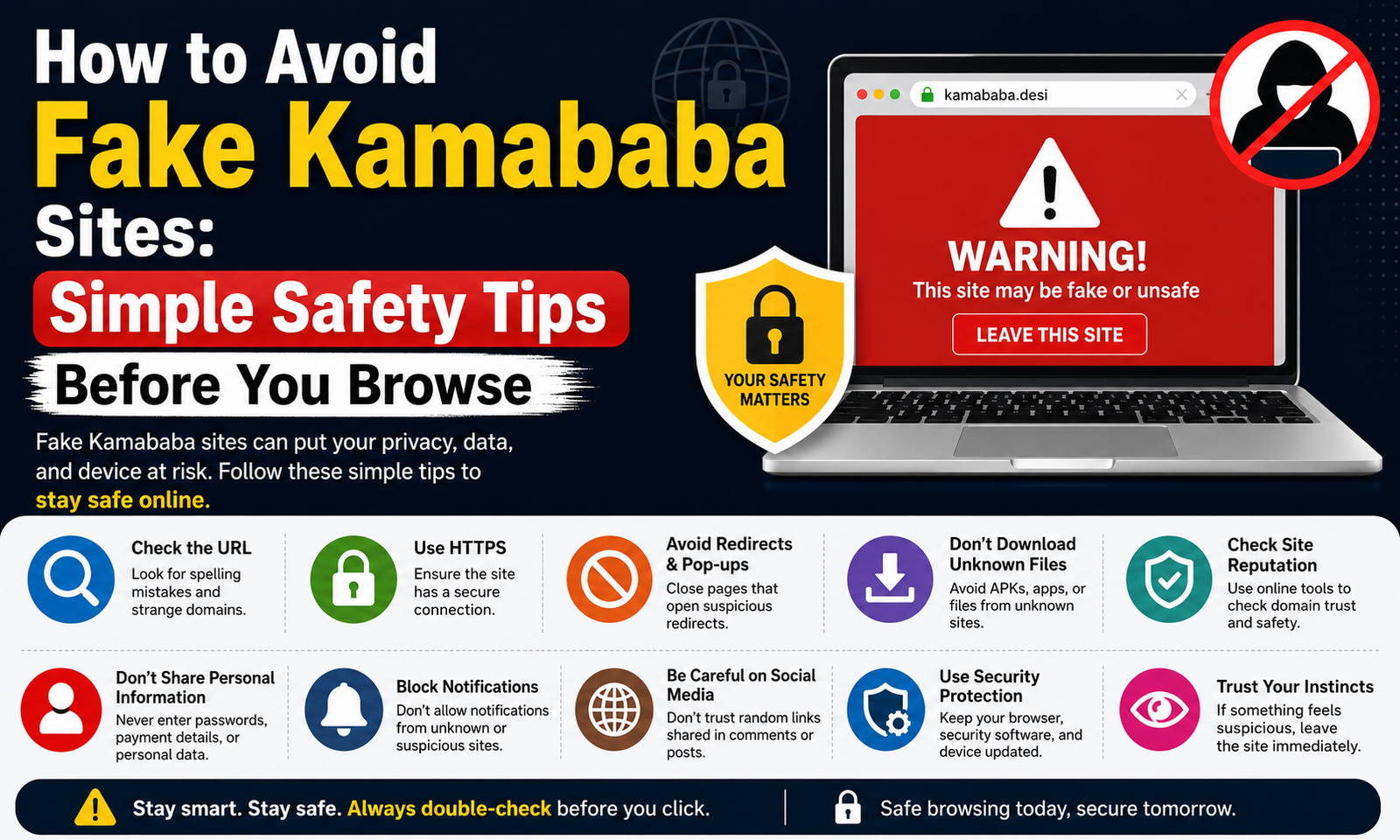
Searching for Kamababa-related pages can sometimes feel confusing because many links, names, and similar-looking domains may appear online. Some pages may look normal at first, but that does not always mean they are safe. This is why knowing How to Avoid Fake Kamababa Sites matters before you open any link, click a play button, allow notifications, or download anything from a random page.
A fake Kamababa site may use a similar name, a changed domain extension, copied design, pop-up ads, or redirects to make visitors believe they are on the right page. Some of these pages may only be made for traffic, while others may try to push unsafe redirects, fake download buttons, browser notification spam, or even phishing pages. The safest approach is simple: slow down, check the link, and never trust a page only because it has Kamababa in the name.
What Fake Kamababa Sites Usually Look Like
Fake sites usually do not look fake right away. Many Kamababa clone websites are made to appear close enough to the real search term so users click without thinking. They may use the same words, similar page titles, copied thumbnails, or a familiar layout. The difference is often hidden in small details.
A fake page may have a domain that adds extra words before or after the name. It may use hyphens, numbers, unusual spellings, or different extensions. Some lookalike domains may include words like “new,” “HD,” “official,” “watch,” “online,” “live,” or “update” to seem more useful than other results.
You may also see Kamababa mirror sites or similar Kamababa sites claiming to provide a working link. Not every similar domain is automatically harmful, but similar names should always be checked carefully. A copied name alone is not proof of trust. In many cases, fake pages depend on users being in a hurry.
The most common warning signs include:
A strange or misspelled URL
Too many ads before the page loads
Pop-ups asking for notification permission
Fake buttons that redirect to another page
Download prompts for APKs or media players
No clear privacy policy or basic site details
Broken menus, copied text, or low-quality design
When several of these signs appear together, treat the page as suspicious.
Why You Should Check a Kamababa Link Before Opening It
Many users search for a Kamababa new link, Kamababa working link, or related website when the page they expected does not open. That is exactly when fake pages become more dangerous. People are usually looking for a quick answer, and scammers often take advantage of that urgency.
A fake site can put your online privacy at risk even if you do not create an account. Some pages may try to track your browsing behavior, push unwanted ads, redirect you to questionable websites, or ask you to allow notifications. Others may show fake security alerts that claim your device has a virus. These alerts are usually designed to scare you into clicking.
A risky page may also try to collect personal details. This could include your email address, phone number, password, payment information, or social login. If a Kamababa-related page asks for sensitive information without a clear reason, that is a major phishing warning.
The goal is not to panic. The goal is to browse with common sense. Most problems can be avoided by checking the website address, avoiding unknown downloads, and leaving the page when something feels forced or suspicious.
Start With the URL: Small Spelling Changes Matter
The URL is the first thing you should check when trying to avoid fake websites. Many fake Kamababa links depend on small spelling changes. A single extra letter, missing letter, hyphen, number, or different extension can send you to a completely different site.
Look carefully at the website address bar before interacting with the page. Do not only read the title that appears in search results. A page title can say anything, but the domain shows where you actually are.
Be careful with URLs that:
Use a slightly changed spelling
Add random words around Kamababa
Use too many hyphens or numbers
Hide the real domain behind a long link
Use shortened links from social media
Send you through several redirects before loading
A spoofed website may include the word Kamababa but still belong to a different domain owner. For example, a page can place a familiar word inside a longer domain to look trustworthy. The important part is the main domain before the extension, not just the words inside the full link.
Before clicking, ask yourself: does this URL look clean, simple, and expected, or does it look like it was made to trick searchers?
Be Careful With Kamababa Links Shared on Social Media
A link shared on social media is not automatically safe. Many users find Kamababa links through comments, groups, video descriptions, short posts, or forum threads. These links may be outdated, copied from somewhere else, or created only to drive traffic to unsafe pages.
This is especially important when a post claims to offer the latest Kamababa link or a guaranteed Kamababa working link. Words like “new,” “active,” “updated,” and “official” can make a link look useful, but they do not prove that the website is safe.
Before opening a link from social media, check who shared it. A newly created profile, spammy comment, repeated link, or copied caption can be a red flag. Also avoid links that are shortened in a way that hides the final destination. If you cannot see where a link is taking you, it is better not to open it.
Some fake pages also use social media to spread fast because people often click from mobile phones. On a small screen, the full URL may be hidden, and that makes mobile browsing safety even more important.
HTTPS Helps, But It Does Not Prove a Site Is Safe
Many people think a website is safe just because it has HTTPS or a lock symbol in the browser. HTTPS is useful because it means the connection between your browser and the website is encrypted. But HTTPS does not prove that the website itself is honest.
A fake site can also use an SSL certificate. That means the lock icon should be treated as one safety signal, not the full answer. You still need to check the domain name, page behavior, pop-ups, redirects, and whether the site asks for private information.
When checking a Kamababa-related page, click the browser’s site information icon or lock symbol if available. Look for certificate details and browser warnings. If your browser says the connection is not secure, the certificate is invalid, or the page may be dangerous, leave the site.
A secure connection is good, but it does not protect you from fake download buttons, misleading ads, copied pages, or scams. Always combine HTTPS with other checks.
Watch Out for Redirects, Pop-Ups, and Fake Play Buttons
One of the easiest ways to spot a risky website is by watching what happens after you land on the page. If the site immediately opens new tabs, sends you to another domain, asks you to allow notifications, or keeps showing pop-ups, it may not be safe.
Many Kamababa scam pages use redirects to move visitors through multiple ad pages. You may click one button and suddenly land somewhere unrelated. Some pages show fake “continue,” “verify,” “play,” or “download” buttons that are actually ads. These buttons may lead to unsafe browser redirects or pages that ask you to install something.
Be careful with messages like:
“Allow notifications to continue”
“Download this player to watch”
“Your device is infected”
“Click here to verify you are not a robot”
“Install this app for full access”
A real safety check should not force you through strange pages or unknown downloads. If the website feels pushy, close the tab. Do not keep clicking just because the first button did not work.
Avoid APKs, Downloads, and Unknown Files
A common trick on fake websites is to push downloads. A page may claim that you need an APK, browser extension, media player, update file, or special app to continue. This is a serious warning sign.
Unknown files can contain malware, adware, spyware, or browser hijackers. Even if the file looks harmless, it may change your browser settings, show unwanted ads, track your activity, or create security problems on your device.
Avoid downloading anything from an unknown Kamababa-related page, especially if:
The file starts downloading automatically
The site asks you to install an APK
The file name looks random
The page says your browser needs an update
The download button appears before any useful content
The website blocks access until you install something
A fake download button is one of the most common traps on unsafe sites. If you did not visit the page to download software, do not download software from it.
Use a Website Safety Checker Before Trusting a Domain
A website safety checker can help you review a domain before you open it or before you interact with it. These tools may show whether a domain has been linked to phishing detection, malware risk, spam activity, suspicious reputation signals, or unsafe behavior.
You can also use a URL scanner, domain reputation checker, or WHOIS lookup to get more context. A domain lookup may show when the site was registered, while a reputation tool may show whether the page has been reported for suspicious activity.
Still, do not rely on one tool only. A new fake website may not be flagged yet. At the same time, a low-risk result does not mean every page, ad, redirect, or pop-up on that domain is safe. Use these tools as part of your safety process, not as the only decision.
A good rule is to check several signals together:
Does the URL look normal?
Does the site load without forced redirects?
Does it avoid suspicious downloads?
Does it have basic privacy details?
Do safety tools show clean results?
Does the browser show any warning?
When these checks line up, you can make a better decision. When they do not, leave the page.
Don’t Assume Every Similar Kamababa Domain Is Real
When a keyword becomes popular, similar domains often appear around it. Some may be fan pages, mirror pages, unrelated websites, parked domains, or copied sites. Others may be made only to catch search traffic. That is why you should never assume that every domain using the Kamababa name is genuine.
Searchers often look for sites like Kamababa, Kamababa alternatives, or a Kamababa website list. These searches can show many results, but ranking in search does not always prove safety. A site can appear in search results and still have annoying ads, redirects, or unclear ownership.
Instead of trusting a domain because it looks familiar, compare the details. Check the spelling, extension, page quality, redirects, and whether the site behaves normally. If two websites look almost identical but use different domains, be extra careful. One may be copied from another, or both may be using the same template.
The safest mindset is simple: similar does not always mean safe.
Check the Page Quality, Privacy Policy, and Basic Details
Fake websites often feel unfinished when you look closely. The homepage may look fine, but deeper pages may be broken or missing. The menu may not work. The text may be copied, badly written, or repeated. The design may be messy, with too many ads covering the actual content.
A trustworthy website usually has basic pages like a privacy policy, contact details, terms, or an About page. These pages do not guarantee safety, but their absence can be a warning sign. A site that collects data, shows ads, or asks users to interact should explain how it handles information.
Look for these fake website signs:
No privacy policy
No contact information
Broken internal links
Poor spelling and grammar
Copied content from other sites
Low-quality images
Overloaded ad placement
No clear page structure
Fake buttons placed near real buttons
A low-quality page is not always dangerous, but it does tell you to be more careful. When poor design appears together with pop-ups, redirects, and strange download prompts, it is better to leave.
Never Share Personal Details on Suspicious Pages
You should not enter personal information on a Kamababa-related page unless you are fully sure the site is legitimate and has a clear reason to ask for it. Many fake websites use simple forms to collect emails, passwords, phone numbers, or payment details.
Be especially careful if a page asks you to sign in with Google, Facebook, or another account. Fake login pages can copy the look of real login screens and steal your password. This is one of the most common forms of phishing scams.
Avoid entering:
Email address
Password
Phone number
Payment details
ID information
Social media login
Personal photos or files
Also avoid using the same password across multiple sites. If one fake page gets your password, it may be used to try logging into your email, social media, or other accounts. Strong passwords and two-factor authentication can reduce the risk.
Your personal information is more valuable than a quick link. If a page feels suspicious, do not give it anything.
Mobile Safety Tips for Kamababa-Related Searches
Many people browse from mobile devices, and that can make fake websites harder to spot. On mobile, the address bar may hide part of the URL. Pop-ups can cover the screen. Fake download buttons may look like normal app prompts. Some pages may even try to push APK files directly.
When browsing on mobile, take a few extra steps:
Tap the address bar and check the full URL
Do not allow notifications from unknown sites
Avoid APK downloads from random pages
Do not install browser extensions or unknown apps
Close pages that open too many tabs
Keep your browser and device updated
Use built-in safe browsing protection
Private browsing can help reduce saved history and cookies, but it does not make a dangerous website safe. A private tab will not protect you from malware downloads, phishing forms, or fake login pages. For real browser protection, you still need careful habits and updated security settings.
Be Careful With Browser Notification Requests
Some fake sites do not need you to download anything. They only need you to click “Allow” on a browser notification request. Once you allow notifications, the site may send spam alerts, fake virus warnings, adult ads, or scam links directly to your device.
If a Kamababa-related page asks you to allow notifications before showing content, treat that as suspicious. Most normal websites do not need notification permission just to let you browse.
If you already allowed notifications by mistake, go into your browser settings and remove that site from allowed notifications. You can also clear site permissions, cookies, and browsing data for that domain.
This simple step can stop many annoying pop-ups and fake alerts.
What to Do If You Clicked a Fake Kamababa Link
Clicking a suspicious link once does not always mean your device is infected. The important thing is what you do next. If the page looked fake, opened redirects, asked for downloads, or showed strange warnings, close it immediately.
Take these steps:
Close the tab or browser window
Do not download anything
Do not enter personal details
Do not allow notifications
Clear site permissions
Remove unknown browser extensions
Scan your device with trusted security software
Change passwords if you entered login details
Check your accounts for unusual activity
If you downloaded a file, do not open it. Delete it and run a malware scan. If you installed an APK or unknown app, remove it from your device and review app permissions.
If you entered a password, change it immediately from the real website or app, not from the suspicious page. Also turn on two-factor authentication where possible.
How to Build Safer Browsing Habits
Avoiding fake Kamababa sites is not about memorizing every possible domain. New pages can appear, old links can stop working, and search results can change. What matters most is building a habit of checking before clicking.
Use search results carefully. Avoid clicking every page that promises instant access. Be skeptical of posts that say “official new link” without proof. Do not trust a page only because it has a familiar name in the title. Look at the domain, page behavior, and safety signals together.
Good safe browsing tips include:
Use an updated browser
Keep safe browsing protection on
Avoid unknown downloads
Do not click every pop-up
Check URLs before opening
Use a domain reputation tool
Avoid sharing personal details
Leave pages that feel suspicious
These habits help not only with Kamababa-related searches but with any website that may be copied, cloned, or used for scams.
Quick Safety Checklist Before You Browse
Before opening any Kamababa-related website, run through this simple Kamababa safety checklist:
Check the full website URL
Look for spelling changes or extra words
Avoid links from spammy comments or unknown profiles
Do not trust HTTPS alone
Watch for redirects and pop-ups
Never click fake play or download buttons
Do not install APKs or unknown files
Do not allow browser notifications
Check the domain with a URL scanner
Look for a privacy policy and basic site details
Avoid entering personal information
Close the page if your browser shows a warning
Scan your device if you downloaded anything
Change passwords if you entered login details
The best way to understand How to Avoid Fake Kamababa Sites is to treat every unknown link with caution. A real-looking name, a lock icon, or a search result position is not enough. Check the URL, watch the page behavior, protect your privacy, and leave quickly when something feels wrong.
